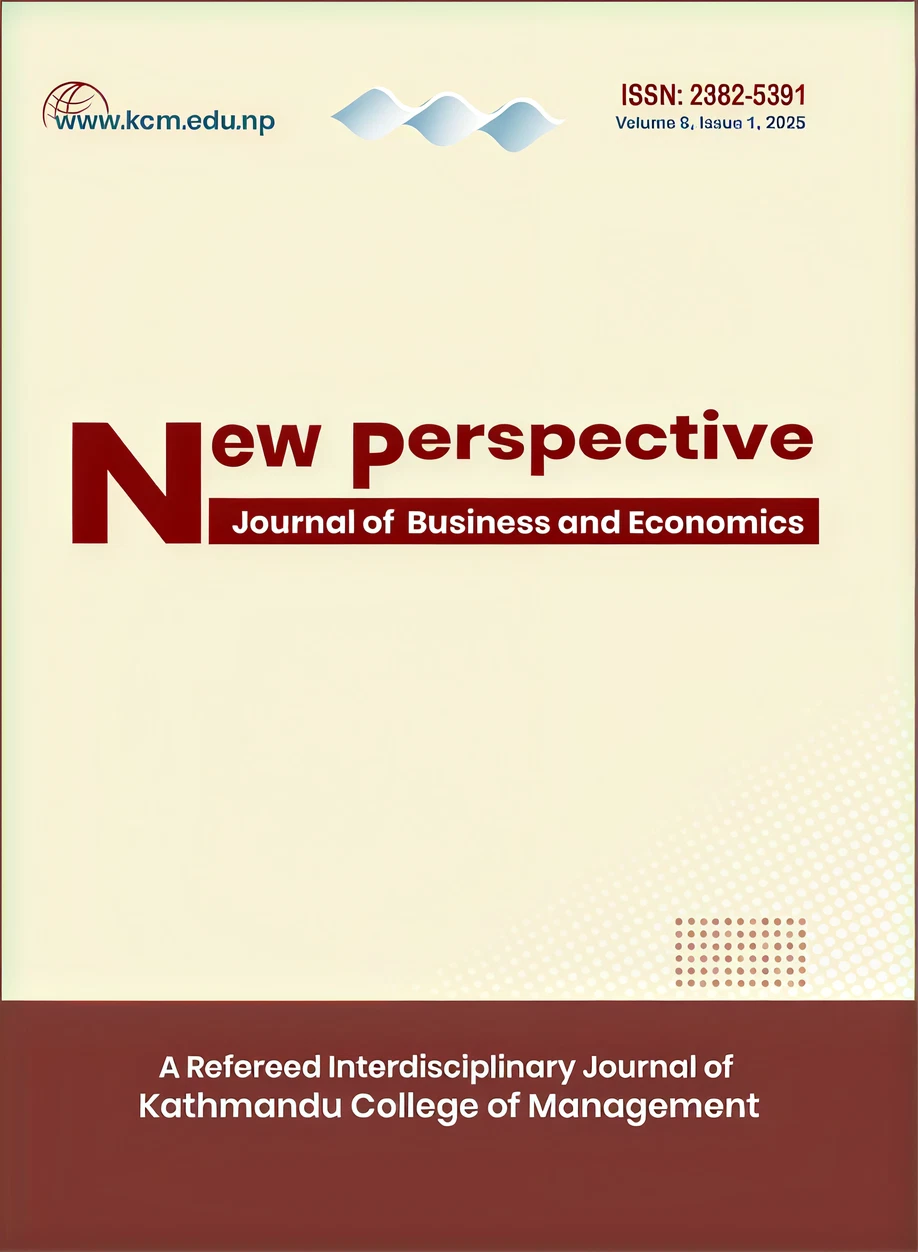
New Perspective: Journal of Business and Economics

Overview

New Perspective: Journal of Business and Economics seeks to bridge the gap between the general business practice and financial press through standard academic journals of business and economics. It publishes articles and reviews highlighting the ongoing research on contemporary issues in the fields of business, economics and management and their impact on management practices.

Aims of the Journal

  • To provide an authentic open-access platform featuring scholarly research, reviews, and perspectives on the state of current research on topics of interdisciplinary interest in Business, economics, information technology and social sciences across managerial disciplines.
  • To offer an academic, not-for-profit, blind peer-reviewed journal for professors, scholars, students, and learned members of the community
Journal Title: New Perspective: Journal of Business and Economics
Frequency Annual
DOI NepJol, crossref, DOI Foundation
Print ISSN 2382- 5391
Online ISSN 2382- 5405

Mission

The mission of the New Perspective Journal of Business and Economics is to create a platform where scholars, experts, and thinkers can exchange informed, critical, and respectful contributions on important topics in business domains across disciplines. The journal aims to serve the larger good of the people by facilitating the dissemination of knowledge and fostering intellectual discourse.

Vision

The vision of the New Perspective: Journal of Business and Economics is to become the leading platform for multi-disciplinary and inter-disciplinary research and writing. The journal aims to cover the new perspective research and become known for its high standards, innovative approach, and impact on the learned community.

  • The New Perspective: Journal of Business and Economics aims to publish high-quality research articles, reviews, and perspectives per issue to improve business management conditions and move forward interdisciplinary and disciplinary discourse.
  • The key objectives of the journal include providing authors with detailed and constructive feedback within weeks of their submission of articles, expanding online readership across continents, keeping a tally of interdisciplinary knowledge and theory building works from the submissions received on making the business discourse more sustainable, smart, and practicable, ensuring the implementation of copyright and intellectual property laws, and exploring tools and resources for visibility of the journal and maintenance of its academic standards for dissemination of research.
  • Additionally, the journal focuses on creating intellectual capital by prescribing and improving business theories and practices and encouraging scientific research into sustainable governance and business ethics. To achieve these objectives, the journal operates a double-blind peer review model and publishes both theoretical and empirical research papers in the general fields of economics and business
Methodology

The New Perspective Journal of Business and Economics follows a rigorous peer-review process led by a team of experts from Nepal and abroad to ensure high quality and impact of published research and writing in pursuit of academic and practicable business. Articles undergo initial editor screening followed by a blind peer review before publication, and submissions are checked for plagiarism. Manuscripts must be between 5 -20 pages, in APA format, that is between 3000-8000 words, excluding references.

Submission

  • Prepare your manuscript according to the APA guidelines. The manuscript should contain all the required sections, including separate Author Information, Abstract, Keywords, Introduction, Materials & Methods, Results, Conclusions, Figures and Tables with Captions, Funding Information, Author Contributions, Conflict of Interest, and other Ethics Statements.

  • This journal invites digital copy of unpublished, original articles and reviews from authors/researchers in APA style such as format (font: Times New Roman, size: 12), title page, author note, abstract, paragraphs, headings, abbreviations, mathematics and statistics, references, unit of measurement, copyright and quotations, tables and figures while submitting contributions.

  • The manuscript should not be published previously nor be under consideration for publication in another journal. The manuscript should be free of errors, including spelling and grammar mistakes. You may want to have someone else review your manuscript before submitting it.

  • Write a cover letter that includes the title of your manuscript, the names and affiliations of all authors, and a brief summary of your research. The cover letter should also explain why your manuscript is a good fit for the journal and highlight any unique contributions your research makes to the field.

  • Attach your manuscript and any supporting materials, such as figures or tables, to the email. Make sure the files are in the correct format and that they are labeled clearly.
    In the email subject line, include the title of your manuscript.

  • Send the email to the journal’s submission email address:

It will be helpful for the authors to keep the electronic files of cover letter, text file, and images ready before submitting a manuscript.
Wait for a response from the journal. The review process can take several weeks or months, so be patient. If your manuscript is accepted, you may be asked to make revisions before it is published.

KCM Publication publishes papers relating to all aspects of business and economics. The emphasis is on quantitative or analytical work, which is relevant as well as intellectually stimulating. The Journal publishes original research papers and reviews; it does not publish book reviews.

The Journal’s policy is to have manuscripts reviewed by expert reviewers. New Perspective Journal of Business and Economics utilizes a double-anonymized peer review process in which the reviewer’s identity is not disclosed to the author and vice versa.

The Journal receives a large number of papers per year and publishes only a small fraction. Therefore, it is important to ensure that your manuscript meets the high standards of the journal in terms of the contribution or value added to the literature, or in terms of methodological rigor.

Peer Review Process

The New Perspective Journal of Business and Economics follows a peer-review process to ensure the quality and impact of published research and writing. Here is an overview of the peer-review process:

01. Initial Screening

Research and review articles received from open calls and individual invitations are subject to initial screening by the Managing Editor. This screening assesses the relevance of the work to the journal.

02. Double-Blind Peer Review

Articles that pass the initial screening undergo a double-blind peer review process. The identities of both the authors and reviewers are kept anonymous. The Section Editors review the articles and submit draft decisions to the Editor-in-Chief for the final decision on further review or acceptance.

03. Short Review Process

The initial review process is short and typically lasts no longer than six weeks. This allows for a timely evaluation of the submissions.

04. Perspectives Review

The initial review process is short and typically lasts no longer than six weeks. This allows for a timely evaluation of the submissions.

05. Conflict of Interest

To avoid conflicts of interest, articles from Editors, Managing Editor and Chief Editor will not be accepted as they are involved in the administration process.

06. Intellectual Support

The names of the Reviewer Board are displayed for assistance in searching for experts in the same area. However, they may not be requested to review the articles to avoid conflicts of interest.

Formatting

Formatting will be done by the journal production team. During the process the copy editor may contract authors if they require any specific information. The final formatted paper will be shared with the authors for their approval as a final chance for correction.

Advisory Board

  • Prof. Prem Raj Pant, Ph.D., Professor, Tribhuvan University, Nepal
  • Prof. Rajan Bahadur Paudel, Ph.D., Professor, Tribhuvan University, Nepal
  • Prof. Puspa Raj Adhikari, Ph.D., Professor, Kathmandu University, Nepal
  • Prof. Kanjanna Mahattanatawe, Dean, School of Science, Siam University, Thailand
  • Bishnu Raj Adhikari, Principal, Kathmandu College of Management, Nepal

Review Board

  • Pradipti Acharya, Kathmandu College of Management, Nepal
  • Pratik Adhikari, Kathmandu College of Management, Nepal
  • Rabin Agrawal, CFA, Kathmandu College of Management, Nepal
  • Hemant Bashyal, CFA, FRM, Kathmandu College of Management, Nepal
  • Amit Pyakurel, CFA, Kathmandu College of Management, Nepal
  • Chalard Chantarasombat, Ph.D., Northeastern University, Thailand
  • Baburam Devkota, Kathmandu College of Management, Nepal
  • Sitaram Dhakal, Kathmandu College of Management, Nepal
  • Mayanath Ghimire, Ph.D., PDF Scholar, Srinivas University, India
  • Durga Nanda Jha, Kathmandu College of Management, Nepal
  • Prof. Shital Kumar Karki, Ph.D., National Open College, Kathmandu
  • A. Dinesh Kumar, Ph.D., California University, USA
  • Chandra Prasad Luitel, Kathmandu College of Management, Nepal
  • Dipak Mahat, Ph.D., Shankar Dev Campus, Kathmandu, Nepal
  • Rupak Mainali, Kathmandu College of Management, Nepal
  • Sanjib Mishra, Ph.D., Valley State College, Chitwan, Nepal
  • Pradip Nepal, Kathmandu College of Management, Nepal
  • Prof. Habibur Rahaman, Ph.D., D. Sc., Director, SASPR Edu International, India
  • MD. Mizanur Rahaman, Ph.D., BRAC Business School, Bangladesh
  • Dhabub Prasai, Kathmandu College of Management, Nepal
  • Suman Rai, Kathmandu College of Management, Nepal
  • Sajag Rana, Kathmandu College of Management, Nepal
  • Chatra Prasad Rimal, Myanglung Campus Terhathum, Nepal
  • Prof. Hamid Seremi, Ph.D., President, Asrar Higher Education Institute, Iran
  • Ajay Shah, Kathmandu College of Management, Nepal
  • Bikash Shrestha, Kathmandu College of Management, Nepal
  • Ojaswi Shrestha, Kathmandu College of Management, Nepal
  • Yashaswi Shrestha, Kathmandu College of Management, Nepal
  • Deeptangshu Thapa, Kathmandu College of Management, Nepal

Editorial Board

  • P.S. Aithal, Ph.D., D. Sc., Srinivas University, India
  • Garry Blair, Ph.D., Keele University, UK
  • Boonyadaa Chongshittiphol, Ph.D., Dean, School of Management, Siam University, Thailand
  • Prof. Sateesh Kumar Ojha, Ph.D., Regional Dean, Lincoln University College, Malaysia
  • Sunil Chaudhary, Ph.D., Kathmandu College of Management, Nepal
  • Ritesh Kumar Thakur, Managing Editor, Kathmandu College of Management, Nepal

Editor in Chief

Publisher

Kathmandu College of Management

Gwarko, Lalitpur, Nepal

977-1-5200746 | 977-1-5200746

Disclaimer

The scholarly papers as reviewed and published by Kathmandu College of Management, Kathmandu, Nepal are the views and opinions of their respective authors and are not the views or opinions of the KCM Publication. The KCM disclaims any harm or loss caused due to the published content to any party.

Language of Publication:

English

Scope:

Multidisciplinary (Management, Economics, Social Science and Technology)